Railway transit in Norway stands among the most sophisticated civil engineering accomplishments in Northern Europe. Due to the high mountain plateaus and glacial valleys separating eastern Norway from the Atlantic seaboard, early railway planners faced daunting geographic hurdles. The resulting routes—specifically the high-altitude Bergen Line (Bergensbanen) and its vertical branch line, the Flåm Railway (Flåmsbana)—provide travellers with seamless, year-round passage through untamed mountain topography.
The Bergen Line (Bergensbanen)
Opened in 1909, the Bergen Line spans approximately 496 kilometres, connecting the capital city of Oslo with the coastal port of Bergen. The line traverses the expansive Hardangervidda mountain plateau—Europe’s largest high-altitude plateau—reaching its highest operational point at Finse Station, 1,222 metres above sea level.
Finse operates without public road connections; it is accessible exclusively by train, foot, or bicycle along the historic navvy construction road (Rallarvegen). The railway corridor crosses extensive snow sheds and tunnels designed to maintain track clearance despite heavy winter blizzards that frequently drop several metres of snow across the arctic alpine tundra.
The Flåm Railway (Flåmsbana): Technical Specifications
Branching off from the Bergen Line at the junction station of Myrdal (elevation 866 metres), the Flåm Railway descends 20.2 kilometres down the steep Flåmsdalen valley to sea level at Flåm on the shores of Aurlandsfjord. Regarded as one of the steepest standard-gauge adhesion railway lines in the world, the route operates without a cogwheel rack system.
Adhesion Engineering Facts
The Flåm Railway maintains an average gradient of 1:18 (5.5%), with 18 of its 20 tunnels hand-hewn through solid rock. Each locomotive operates with five independent braking mechanisms—including rheostatic dynamic brakes and dual mechanical track-shoe systems—capable of safely halting the train under emergency conditions without wheel locking.
The "Norway in a Nutshell" Transit Combination
The self-guided transit itinerary widely referred to as "Norway in a Nutshell" leverages coordinated public transport timetables between national rail carrier Vy, local regional bus networks, and electric passenger vessels. The typical westbound progression runs:
- Oslo Central to Myrdal: 4.5 hours across the rolling forests of Hallingdal and the high alpine plateau of Hardangervidda.
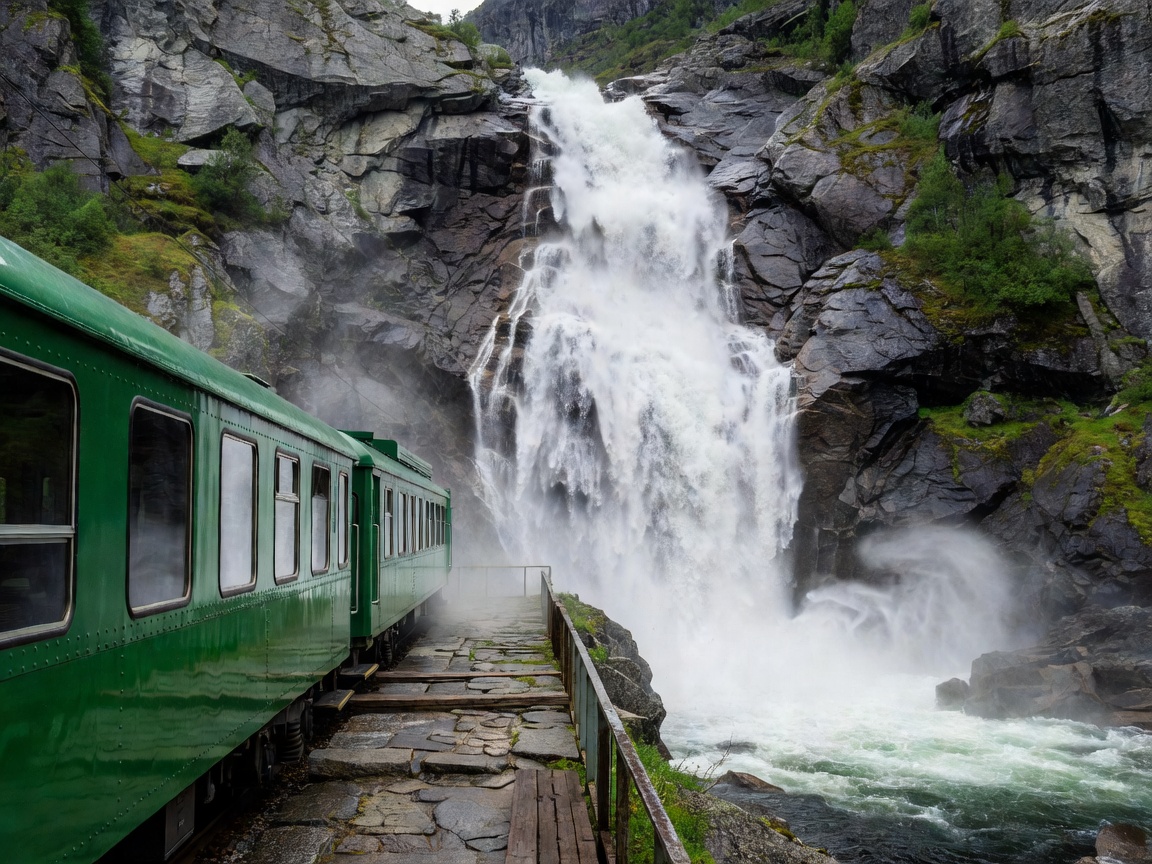
- Myrdal to Flåm: 55-minute descent on the Flåmsbana, including a five-minute viewing pause beside the roaring Kjosfossen waterfall.
- Flåm to Gudvangen: 2-hour electric ferry cruise along the narrow waters of Nærøyfjord.
- Gudvangen to Voss: 45-minute connecting bus passing through the valley corridors of Nærøydalen.
- Voss to Bergen: 1-hour regional train transit arriving at Bergen Central Station.
Railway Route Comparison
| Route Characteristic | The Bergen Line (Bergensbanen) | The Flåm Railway (Flåmsbana) | The Rauma Line (Raumabanen) |
|---|---|---|---|
| Terminus Points | Oslo Central to Bergen Station | Myrdal to Flåm Station | Dombås to Åndalsnes |
| Highest Point | 1,222 m (Finse Station) | 866 m (Myrdal Station) | 659 m (Dombås Station) |
| Primary Scenery | Alpine tundra, glacial ridges, pine forests | Vertical valley walls, hanging waterfalls | Trollveggen cliff face, Kylling Bridge |
| Transit Duration | Approx. 6.5 to 7 hours full route | Approx. 55 minutes descent/ascent | Approx. 1 hour 40 minutes |
| Onboard Amenities | Dining car, Wi-Fi, power outlets, sleeper cabins | Multilingual audio, viewing windows | Scenic commentary, large picture windows |
Pros and Cons of Rail Exploration
Key Advantages of Train Travel
Railway transit relieves travellers from navigating narrow mountain hairpin roads, paying multiple road toll segments, or managing winter snow chains. It remains operational during severe winter storms when vehicular mountain passes are closed by authorities.
Practical Limitations
Luggage transfer requires physical management during tight multi-leg transfers at Myrdal and Gudvangen. Summer passenger demand on the Flåmsbana is exceptionally high, making pre-booking mandatory weeks ahead of departure.
Rallarvegen: The Navvy Cycling Route
For outdoor enthusiasts traveling between July and September, the service road constructed to build the Bergen Line—known as the Rallarvegen—serves as Norway’s premier alpine bicycle route. Spanning from Haugastøl past Finse down to Flåm, cyclists traverse 82 kilometres of gravel trail beside glaciers and roaring mountain rivers before coasting down the 21 hairpin switchbacks of the Myrdalsberget into the Flåm valley.